
Blog
The History of Currency in Turkey: From the Ottoman Era to the Modern Lira

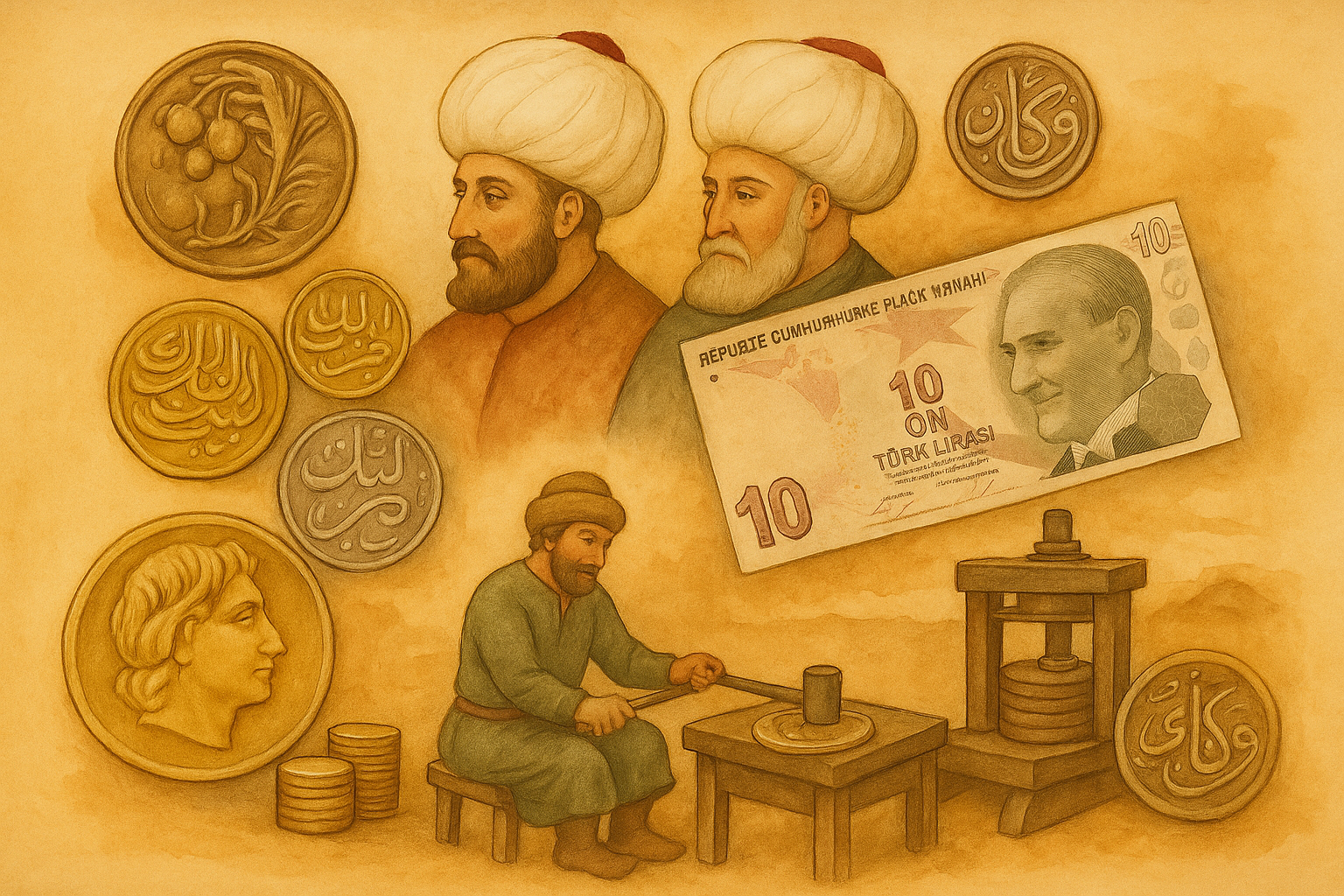
With the beginning of the Ottoman era in the 14th century, coinage in Anatolia entered a new phase that reflected the transformation of the state from a small principality into a vast empire spanning three continents.
Ottoman coins were not merely tools for trade; they were living documents that recorded the reigns of sultans and reflected the phases of expansion, prosperity, and sometimes decline. With the fall of the Ottoman Empire and the establishment of the modern Republic of Turkey, the country entered a completely different monetary era, witnessing the birth of the Turkish lira and its rapid development to the present day.
The Ottoman Empire (1299–1922)
The Ottoman Monetary System and Its Development
Akçe: The first Ottoman silver coin, appeared in the 14th century.
Kuruş: Silver coin, began to be used in the 17th century.
Sultani (Altın): Gold coin weighing about 3.45 g, introduced during the reign of Mehmed the Conqueror (~1477).
Mangır: Copper coin for daily transactions, minted in Istanbul, Bursa, Aleppo, and Cairo.
The Monetary Reform of 1844
Adoption of the system 1 lira = 100 kuruş.
Introduction of the gold lira as the main unit, with the kuruş continuing as a subunit.
Ottoman Paper Money
Abdulmejid I (1839–1861)
Issued the first paper money, called "Kaime-i Nakdiye-i Mutebere" in 1840.
The first issue was handwritten; printing began in 1842.
Denominations: 1, 5, 10, 20, 50, 100, and 250 kuruş.
Abdulaziz (1861–1876)
Established the Ottoman Bank in 1863 and granted it the authority to issue banknotes.
Notes were printed in England and France with ornate calligraphy.
Notable denominations: 200 kuruş, 2.5 lira, 5 lira.
Abdulhamid II (1876–1909)
Continued issuance by the Ottoman Bank, alongside state-issued notes.
Featured beautiful Islamic and artistic decorations.
Denominations up to 1,000 kuruş.
Mehmed V Reşad (1909–1918)
Issued Evrak-ı Nakdiye in 1915, printed in Germany.
Introduced unprecedented denominations up to 1,000 lira.
Mehmed VI Vahideddin (1918–1922)
No new issues; notes from Mehmed Reşad’s reign remained in circulation until 1927.
The Republic of Turkey (1923–Present)
The Beginning of the Turkish Lira
First paper issue: 1927.
Printed abroad until 1958, then at the Ankara printing facility.
Series of Turkish Banknotes
E1 – First Issue (1927–1939)
Denominations: 1, 5, 10, 50, 100, 500, 1,000 lira.
Issued: 5 December 1927.
Obverse: Symbols of the Republic, Parliament, Ankara architecture.
Reverse: Akköprü, Ankara Castle, railways, some notes with Atatürk’s portrait.
Printing: Thomas De La Rue, UK.
E2 – Second Issue (1937–1944)
Denominations: 50 kuruş to 1,000 lira.
Obverse: İsmet İnönü.
Reverse: Central Bank, Bosphorus, Victory Monument.
Printing: UK.
E3 – Third Issue (1942–1947)
Denominations: 2.5, 10, 50, 100, 500, 1,000 lira.
Obverse: İnönü.
Reverse: Technical schools, Turkish women, Angora goats, cultural institutions.
Printing: UK, Germany, USA.
E4 – Fourth Issue (1947–1952)
Denominations: 10 and 100 lira.
Obverse: İnönü.
Reverse: Sultan Ahmed Fountain, Rumeli Fortress.
Printing: USA.
E5 – Fifth Issue (1951–1971)
Denominations: 2.5, 5, 10, 50, 100, 500, 1,000 lira.
Obverse: Always Atatürk’s portrait.
Reverse: Girls with walnuts, Youth Park, Sultan Mosque.
Printing: Abroad until 1958, then Ankara.
E6 – Sixth Issue (1966–~1986)
Denominations: 5, 10, 20, 50, 100, 500, 1,000 lira.
Obverse: Atatürk.
Reverse: Manavgat Waterfall, Maiden’s Tower, Mount Ararat, Istanbul University.
Printing: Ankara.
E7 – Seventh Issue (1981–~2005)
Denominations: 10 to 20 million lira (due to inflation).
Obverse: Atatürk, sometimes cultural figures.
Reverse: Mevlana, Piri Reis map, Ephesus ruins, dams, Anıtkabir.
Printing: Ankara.
E8 – Eighth Issue (2005–2009)
Denominations: 1, 5, 10, 20, 50, 100 YTL.
Note: Six zeros removed from the currency.
Obverse: Atatürk.
Reverse: Landmarks such as Atatürk Dam, Anıtkabir, Cappadocia, Ishak Pasha Palace.
Printing: Ankara.
E9 – Ninth Issue (2009–Present)
Denominations: ₺5, ₺10, ₺20, ₺50, ₺100, ₺200.
Obverse: Atatürk.
Reverse: Prominent figures:
₺5 – Aydın Sayılı
₺10 – Cahit Arf
₺20 – Mimar Kemaleddin
₺50 – Fatma Aliye
₺100 – Itri
₺200 – Yunus Emre
Printing: Ankara.
Summary Table
| Series | Period | Denominations | Obverse | Reverse | Printing Location |
|---|---|---|---|---|---|
| E1 | 1927–1939 | 1–1,000 lira | Republic symbols | Ankara landmarks | UK |
| E2 | 1937–1944 | up to 1,000 | İnönü | National monuments, Bosphorus | London |
| E3 | 1942–1947 | up to 1,000 | İnönü | Schools, cultural scenes | UK, Germany, USA |
| E4 | 1947–1952 | 10, 100 lira | İnönü | Sultan Ahmed Fountain, Rumeli Fortress | USA |
| E5 | 1951–1971 | up to 1,000 | Atatürk | Nuts, gardens, mosques | Abroad, then Ankara |
| E6 | 1966–1986 | up to 1,000 | Atatürk | Natural landscapes | Ankara |
| E7 | 1981–2005 | up to 20M | Atatürk | Mevlana, maps, dams | Ankara |
| E8 | 2005–2009 | 1–100 YTL | Atatürk | National landmarks | Ankara |
| E9 | 2009–present | ₺5–₺200 | Atatürk | Scientists, cultural figures | Ankara |
Security Features of Modern Turkish Banknotes
Holographic strip.
Security thread visible under UV light.
Variable-size numerals.
Different note sizes for each denomination.
Conclusion
The history of currency in Turkey represents a complete journey from the simple Ottoman akçe to the modern Turkish lira, reflecting the political and economic transformations the country has experienced over the centuries.


